
Somewhere on your roster, something has already expired.
It happens to good departments. Usually nobody notices for months.
We watch every license and clinical card your providers carry. They get warned before anything expires, your coordinator stops chasing it, and the record is ready before anybody asks for it. A flat monthly fee, and no spreadsheet.
Designed and built by a current firefighter paramedic
Department loginAlready a client? See your rosterForty providers. Five credentials each. Two hundred expiration dates.
Not one of them should be the one that falls through. Each renewal runs on its own clock, set by whenever that provider last certified — so the dates never align and the list never sits still. Add new hires, departures, and a coordinator carrying this on top of a full assignment, and a credential slipping past is not carelessness. It is arithmetic.
The costly part is when you find out. A lapse discovered three weeks before an inspection is a scramble. Discovered during one, it is a finding — and the provider has been running calls on it the whole time.
It is somebody’s third job
Tracking lands on a coordinator who is also running shifts, covering calls and answering to the medical director. It works right up until the week they are busy — and that is every week. The spreadsheet does not fail loudly. It just quietly stops being true.
You find out afterward
A card expired in March and nobody noticed until June. In the meantime that provider was on the truck running calls on a credential that had already run out. Everything is fine until the one time it is not, and then it is a problem for the provider and for the service.
Your CE provider only sees its own hours
Whatever you use for continuing education watches the hours it delivered. It does not watch a state certification, a National Registry date, or an ACLS card somebody earned somewhere else. Those live in a different place, or in no place at all.
The scramble is the tell
If proving every provider is current means a day of digging through folders, emails and two systems, those are not really records. They are a reconstruction, done under pressure, every single time somebody asks.
Every one of these works. Until the week it does not.
None of these are careless. They are what a sensible person does with the time they have. They just all share the same blind spot — nothing in them is watching while nobody is looking.
What changes with us is not the record. It is the watching. The dates still belong to your department. The difference is that something checks them every night and tells the right person ninety days out — whether anybody remembered to look or not.
It is not a paperwork problem. It is a staffing one.
Massachusetts requires an ambulance to be staffed by EMTs certified at the level the service is licensed for. A provider whose certification has run out does not meet that standard — and neither does the truck he is riding.
Every call, retroactively
A card that expired in March does not fail in June when somebody notices. It failed in March, and every call since was run by a provider who was not certified to run it.
The provider, personally
It is their certification. They are the one who has to explain it, and they are the one who cannot work until it is sorted.
The person who was meant to be watching
Nobody asks the spreadsheet why it was out of date. They ask the coordinator, who had three other jobs and no warning.
And it is on the record
Found during an inspection rather than before one, it stops being an internal fix and becomes a finding against the service.
None of that is caused by the lapse. It is caused by nobody knowing about it for three months.
You are already required to have this under control.
Nothing here requires our service, and we will never tell you it does. But these are the rules you already live under, and this is a way to satisfy them without a spreadsheet.
Written policies on certification and recertification
Massachusetts requires every ambulance service to keep written policies that are comprehensive and reflect current day-to-day operations, across 29 areas. The first one on the state's own list is certification and recertification of EMTs.
Staffing with currently certified people
An ambulance has to be staffed by EMTs certified at the level the service is licensed for. A credential that quietly expired is not only a paperwork problem — it is a staffing one.
EMS personnel, generally
The general provisions governing certification of EMS personnel in Massachusetts, and the authority OEMS works from when it asks a service to account for its people.
Emergency responder health and safety
The current standard covering responder training and qualification records. It replaced NFPA 1500 in January 2024, consolidating 1500, 1521 and 1561 into one document.
Citations are given so you can read them yourself. Your department remains responsible for its own compliance, and nothing on this page is legal advice.
Every EMS credential your providers carry.
Keep the continuing education provider you already use. We are not replacing it — we watch the credentials it does not.
State certification
Every 2 years
Massachusetts OEMS, at the provider's level
National medic cert
Every 2 years
National Registry
BLS
Every 2 years
Basic Life Support provider card
ACLS
Every 2 years
Advanced Cardiovascular Life Support
PALS
Every 2 years
Pediatric Advanced Life Support
Those five are what we track as standard, and they are the ones that lapse. Every department gets its own list. Tell us what your people actually carry — trauma cards, medical director credentialing, Nero’s Law, ASHER, glucometer or 12-lead competency, driver’s licenses and CDL medical cards if you track those, whatever is on your books — and we build the tracking around your department rather than handing you somebody else’s template. A larger list may affect the price; we will tell you before, not after. We do not track apparatus, gear or fire certifications, because those need somebody physically putting hands on them.
Keep what you use for continuing education.
Whatever you run for CE watches the hours it delivered. That is what it is for, and it does it well. It was never built to watch a card somebody earned at a different agency six years ago.
We are not asking you to replace anything, and we do not import from or compete with your CE platform. We watch the dates it was never meant to watch.
Four steps, and three of them are ours.
We load it for you
Send the roster and whatever you keep now — a spreadsheet, a binder, an export from your continuing education provider. We enter every provider and every date ourselves. Nobody on your end does data entry to get started.
You get a department login
The chief and the EMS coordinator see the whole service on one screen: who is current, who is inside ninety days, whose card has already run out. Providers can be given their own view of just their own record.
The reminders go out on their own
Ninety, sixty, thirty and seven days before anything expires, an email goes to the provider and to the coordinator. Nobody has to remember to check, and nobody has to remember to send it.
You get a report every month
On the first of the month, a one-page summary of where the service stands, and a full record any time somebody asks for it. Printed, dated, and ready to hand over.
One screen. Green, yellow, red.
Lapsed credentials sort to the top, because those are the ones that matter today. Search a provider by name or rank, filter to a single credential, and generate a dated record to hand over — all without anyone on your end entering a thing.
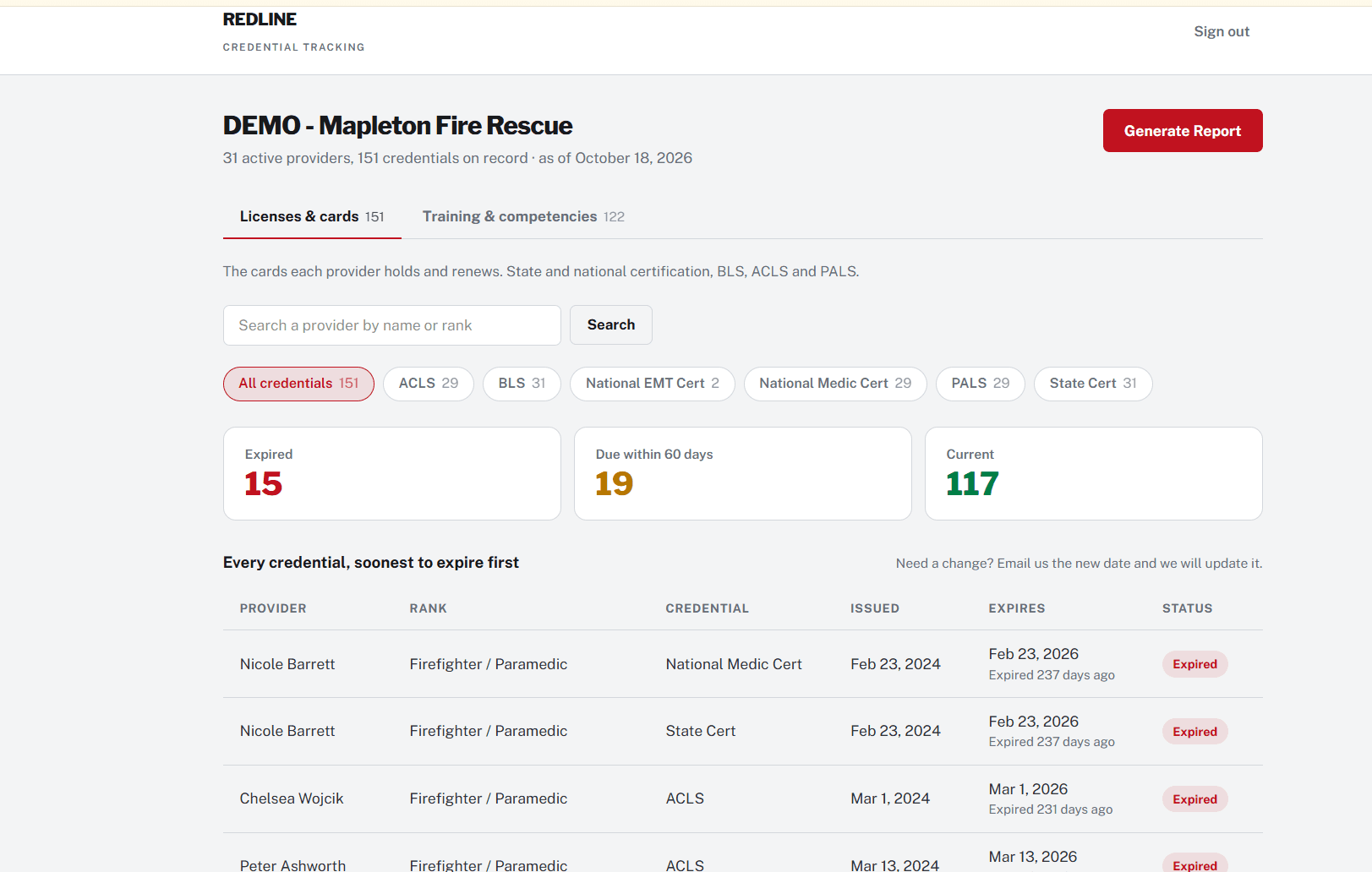
A demonstration department, with the numbers a 31-provider service actually carries. Ask and we will walk you through the live screen.
Four warnings, then it is on the report.
Nobody has to log in to find out something is coming due. The emails go out whether anyone is paying attention or not, and your coordinator is copied on every one.
Provider and coordinator. Early enough to do something about it.
Reminder, with what is still outstanding.
Marked urgent on the dashboard and in the digest.
Final notice, and it moves to the lapsed list on the dashboard.
And a monthly note even when nothing is wrong
On the first of every month you hear from us either way — including the months when every provider is current and there is nothing to do. Silence should never be the thing you have to interpret.
One flat fee for the department.
Not per card, and not a per-seat license that grows every time you swear somebody in. One price for the department, whatever the roster does.
What onboarding covers
We build the department out ourselves — every provider, every credential, every current date, entered and checked against what you sent us. You hand over a spreadsheet and a roster. Nobody on your end does data entry.
Why annual
The yearly price is ten months’ worth for twelve months of service. One invoice against one purchase order, dated to your fiscal year — far easier for a treasurer than twelve small bills, and it is how a town is set up to buy. Monthly is available if you would rather, at the rate shown under each tier.
Your price is locked
The rate you start on is the rate you keep, for as long as you stay with us. No annual increase. Departments that come on early are the reason this exists, and they should not be the ones who end up paying more later.
Built by somebody who is still on the truck.
A working paramedic built this
This came from a firefighter paramedic in Massachusetts who has sat on the wrong side of this problem. The credentials are the ones you actually carry, named the way you actually name them, on the cycles they actually run.
One job, and nothing else
We do not deliver training, book your classes or manage your calendar. Your department handles its own training, and nothing here is a sales funnel pointed at your budget. We watch the dates and we tell you before they arrive. That is the entire service.
Dates only, nothing clinical
We hold a name, a credential and two dates. No patient information, no medical detail, nothing from a personnel file. Each department sees only its own providers, enforced at the database, not by a setting somebody could get wrong.
Your records are yours
Your department stays the official keeper of its own training records — this is the tool that watches the dates, not the file of record. Ask any time and we will hand over a full export of everything we hold. No contract and no notice period.
Send us your roster and we will tell you who is lapsed.
Names and dates is enough — whatever format you keep it in. We will come back with who has already expired and who expires in the next ninety days. No charge and no obligation. If it comes back clean, you run a tight service and now you can prove it.

On-site CPR, AED, and safety certification management for businesses that can’t afford to miss a deadline. Career firefighter paramedic owned and operated, based in Massachusetts.
© 2026 Redline Safety Management. All rights reserved.